
The EU just made PFAS monitoring the law. The UK hasn't.
Source: Environmental Technology
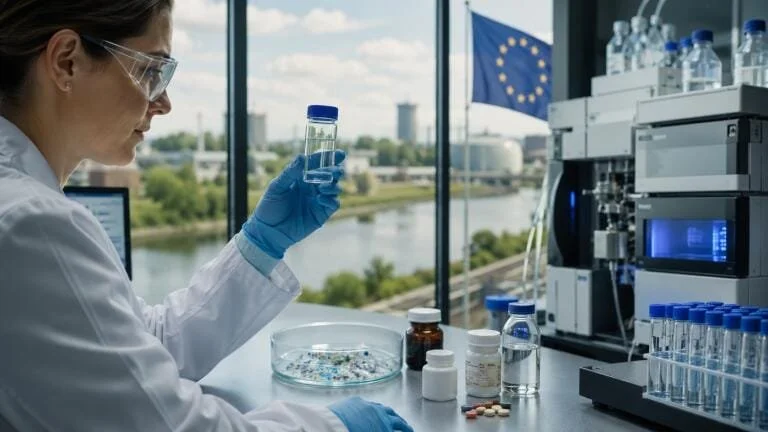
New European standards for PFAS, pharmaceuticals and microplastics in water entered force this week.
The European Environment Agency confirmed this week that new measures protecting European waters from PFAS, pharmaceuticals and microplastics are now legally in force across EU member states.
EU water companies, operators, and the laboratories that serve them now have binding obligations to monitor for a range of persistent chemicals that UK counterparts are not yet required to measure at all. The UK has no equivalent statutory framework.
What the EEA has just formalised – a harmonised monitoring regime for some of the most consequential contaminants of the current era – the UK is still consulting about.
What the new measures require
The new standards update the Environmental Quality Standards under the Water Framework Directive, adding PFAS, selected pharmaceutical compounds and microplastics to the Watch List and, in some cases, the Priority Substances list.
This matters for laboratories because it is not simply a matter of adding parameters to a monitoring schedule. For many of the compounds now covered, the analytical methods required to measure them reliably do not yet exist in agreed, standardised form.
ISO and CEN working groups are active on PFAS methods but progress is incomplete.
For many of the newer PFAS replacement compounds – introduced after restrictions on PFOS and PFOA – there are no validated reference methods, no certified reference materials, and in many cases no consensus on what sample preparation protocols produce reproducible results.
Regulators in member states are now writing compliance expectations around substances that their accredited laboratories are not yet equipped to measure consistently.
This is not a criticism of the regulatory direction. Bringing PFAS, pharmaceuticals and microplastics into statutory water monitoring is overdue.
But it does create an immediate and practical question for instrument manufacturers, commercial laboratories and accreditation bodies: how do you demonstrate compliance against a limit when the method to measure against it is still being developed?
The UK's statutory vacuum
The UK published its PFAS Plan in February 2026, committing to new statutory limits for PFAS in drinking water and expanded monitoring across water, soil, food contact materials and consumer products.
The plan acknowledges that existing sampling data is limited – covering only 11 sludge treatment sites – and that research into how PFAS behave once applied to agricultural land is 'ongoing and incomplete'.
Meanwhile, approximately 94% of sludge from UK water companies is currently recycled to agricultural land.
What concentrations of PFAS compounds are travelling with it, and what happens to them once they enter the soil and water system, is not systematically monitored.
The gap between the UK and EU positions is now measurable. EU operators have statutory obligations. UK operators have a plan to develop them.
For businesses and laboratories operating across both markets – and for UK water companies aware that EU agricultural imports and supply chain claims will increasingly be assessed against EU-standard data – the practical consequence of that gap will become apparent quickly.
What this means for UK laboratories
UKAS has not yet published a programme for accrediting UK laboratories to PFAS analysis methods that do not yet have agreed standards.
Method development takes time and validation resources.
What UK laboratories are navigating is a situation in which they know statutory limits are coming, know that their current capabilities are likely to fall short of what will be required, but have no confirmed timeline or method specification to invest against.
Equipment purchasing decisions, staff training, and instrument procurement all require certainty that the regulatory pipeline is not yet providing.
The EU's move this week tightens that timeline. UK regulators working on the PFAS Plan implementation will be watching the early experience of EU member state labs closely. The question of whether UK methods can be developed in time – and whether accreditation infrastructure will be in place before statutory limits bite – is one the analytical community should be pushing hard on now, not when the consultation closes.
The EU has made its choice. The UK has not yet made its monitoring architecture match its ambition.